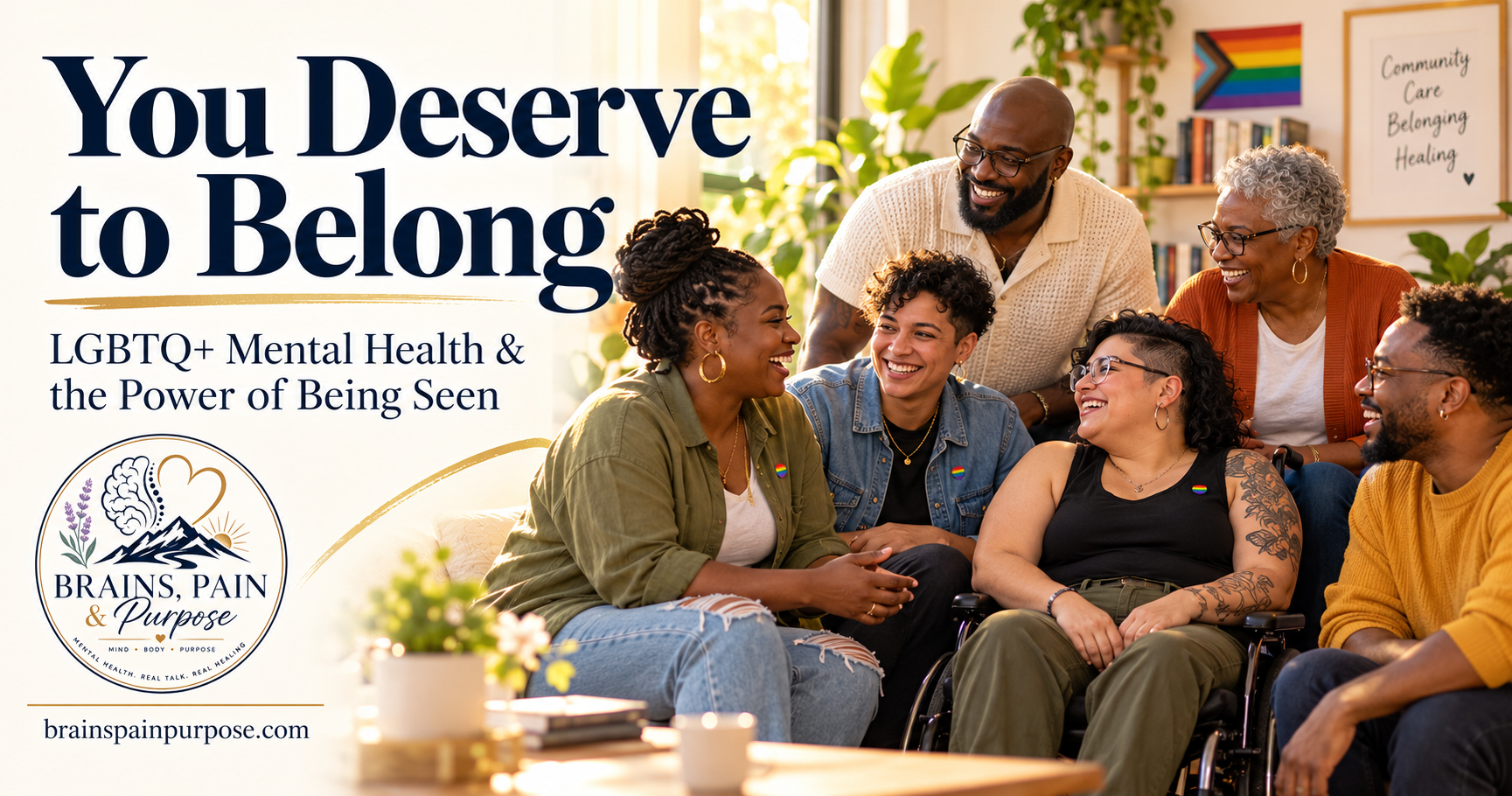
By Sheena, MSN, APRN, PMHNP-BC | Brains, Pain & Purpose
Imagine walking into a family gathering and spending the first few minutes deciding which parts of your life you can safely mention.
Can you talk about the person you love? Will someone turn your identity into a debate? Will you spend dinner laughing—or preparing yourself for a comment everyone else expects you to ignore?
For some LGBTQ+ people, that calculation is familiar. It can happen at home, at work, in a classroom, or even in a healthcare office.
Everyone deserves places where being themselves does not require an explanation. At Brains, Pain & Purpose, that includes LGBTQ+ people: their mental health, relationships, everyday struggles, and joy.
Start with the person
LGBTQ+ includes lesbian, gay, bisexual, transgender, queer or questioning people, with the plus sign recognizing additional identities. Sexual orientation and gender identity describe different aspects of a person’s experience. No acronym tells you everything about an individual.
People within this community have different cultures, beliefs, abilities, family structures, and life stories. A Black lesbian grandmother, a bisexual college student, and a transgender teenager may have some shared experiences, but their needs will not be identical.
The best place to begin is with curiosity that respects boundaries:
“What would you like me to understand about your experience?”
Then make room for the answer.
Belonging affects how life feels
Think about how much easier it is to exhale around someone who accepts you. You do not have to rehearse every sentence or wonder whether affection will disappear when you speak honestly.
Now imagine regularly having to make those calculations. Rejection, harassment, and uncertainty about safety can add stress to ordinary responsibilities. Someone may be navigating school, bills, caregiving, or chronic illness while also deciding where it is safe to be open.
CDC guidance identifies stigma, bias, and school violence as concerns for LGBTQ+ youth and describes supportive environments as an important part of improving their well-being. It also notes that family acceptance is linked with positive health outcomes. These findings concern young people specifically; they help explain why everyday environments deserve our attention. www.cdc.gov
That does not mean every LGBTQ+ person is struggling. It means we should ask what a person is experiencing instead of making assumptions about their mental health.
What support sounds like at home
If someone shares their identity with you, they may have spent considerable time deciding whether to tell you. Your first response does not need to be a speech.
Try:
- “Thank you for trusting me.”
- “I love you.”
- “What would feel supportive right now?”
- “Who else knows, and what would you like kept private?”
You may need time to learn unfamiliar terms or examine your own expectations. Seek that education without making your loved one responsible for managing every feeling you have.
Protect their privacy. Sharing their identity with relatives, coworkers, or a faith community without permission can expose them to consequences you may not anticipate. Ask before sharing, including on social media.
For parents and caregivers, support also lives in ordinary moments: how you respond to a joke, whether a partner is welcomed, and whether your child knows they can tell you when something hurts.
Make inclusion visible in everyday behavior
A rainbow graphic can communicate welcome. What happens after someone walks through the door matters, too.
Use the name and pronouns someone shares with you. If you make a mistake, correct it briefly and continue. Avoid turning the moment into a long apology that requires them to comfort you.
Interrupt dismissive comments. “Let’s keep this respectful” can establish a boundary without asking the targeted person to defend themselves.
Notice who gets included in conversation. If everyone else can talk casually about a spouse or a weekend date, an LGBTQ+ person should have that same room to share.
Support for young people also requires attention to their surroundings. CDC guidance recommends practices such as staff training, supportive school policies, student-led clubs, and spaces where students can seek nonjudgmental support. www.cdc.gov
Healthcare should make room for the whole person
An LGBTQ+ person seeking help for migraines, sleep problems, anxiety, or chronic pain deserves a careful assessment of the concern they brought to the appointment.
Respectful care makes space for identity where it is relevant while recognizing everything else about the person. Useful questions when looking for a provider include:
- “What experience do you have working with LGBTQ+ patients?”
- “How do you handle names, pronouns, and confidentiality?”
- “Can we discuss how family stress or discrimination may relate to what I’m experiencing?”
The provider’s response can help you assess whether you feel heard and comfortable asking questions. You deserve explanations you understand and an opportunity to participate in decisions about your care.
There is room for joy here
LGBTQ+ life includes friendship, creativity, faith, family, romance, ordinary routines, and laughter that arrives at exactly the right moment.
There are chosen families who show up with dinner. There are parents learning how to support their children. There are older adults finding community and young people imagining futures that feel like their own.
Making room for those stories matters. Nobody should have to be in pain before their experience becomes worth hearing.
If you are LGBTQ+ and reading this, you get to decide what to share, with whom, and when. You do not owe everyone access to your story. You deserve relationships where care is consistent and your boundaries are respected.
A moment to reflect
Ask yourself:
- When someone trusts me with something personal, do I listen before responding?
- Does my behavior make room for people whose lives differ from mine?
- What is one specific thing I can do this week to help someone feel welcome?
Perhaps it is checking in privately, correcting a dismissive comment, or learning something you have expected someone else to explain.
Belonging grows through repeated acts of care. Start with one you can practice today.
Share this post with someone who wants to offer more thoughtful support. Explore more conversations about mental health, chronic illness, and everyday life at brainspainpurpose.com.
You are more than your pain. Your story is still being written and you are the author of that story.
This article provides general education and does not replace individualized mental health or medical care.
Source: Centers for Disease Control and Prevention. Supporting LGBTQ+ Youth. November 29, 2024.
Leave a Reply